Best AI Tools for Digital Marketing in 2026: The Ultimate Guide
The Marketing Stack Has Changed More in 2 Years Than the Previous 10
Digital marketing used to mean a content calendar, an email tool, and a spreadsheet of keywords. In 2026, a lean one-person operation can now write, optimize, design, and distribute content at a volume that used to require a five-person team — provided you pick the right tools and actually learn to use them well.
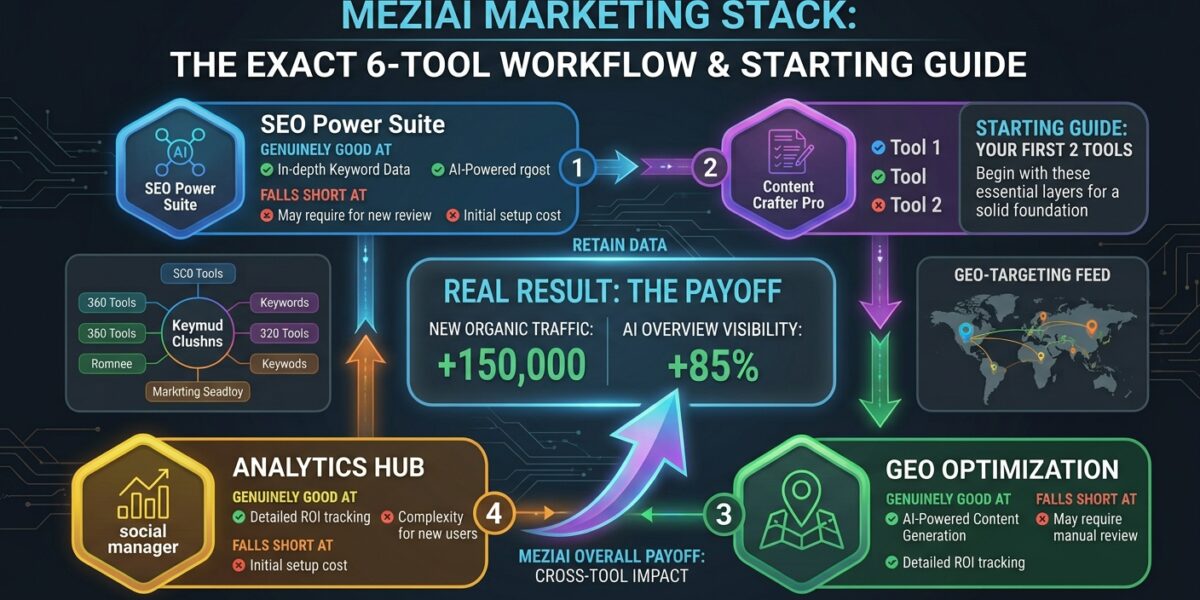
This isn’t a “top 50 tools” listicle. It’s the six tools we personally run MeziAI on, what each one is actually good at, and — just as importantly — where each one falls short.
1. Jasper AI — Long-Form Content at Scale
Jasper remains the strongest option for producing long-form drafts that don’t read like they were generated in ten seconds. Its brand voice training is what separates it from a generic ChatGPT wrapper — feed it 3–5 examples of your best writing and it holds tone consistently across dozens of articles.
Where it falls short: factual accuracy on niche technical topics. Every Jasper draft on this site goes through a human fact-check pass before publishing — treat it as a first-draft engine, not a publish-ready one.
2. Surfer SEO — Closing the Gap Between Written and Ranked
Writing good content and writing content that ranks are two different skills. Surfer bridges them by scoring your draft against what’s actually ranking for your target keyword — word count, heading structure, term frequency, and related terms you’re probably missing.
We run every article through Surfer before publishing. It’s the single highest-ROI tool in our stack relative to its price.
3. Beehiiv — The Newsletter Platform Built to Monetize
Most email platforms treat monetization as an afterthought. Beehiiv builds it in from day one — native ad network access, subscriber referral programs, and paid subscription tiers, all without duct-taping together three separate tools.
Our newsletter runs entirely on Beehiiv, and the first sponsorship deal came through their ad network with zero outbound pitching on our part.
4. Semrush — Still the Standard for Keyword and Competitor Research
For all the AI tools reshaping content production, keyword research still comes down to real search data — and Semrush remains the most complete single source for it. Keyword difficulty, SERP feature tracking, and competitor gap analysis all live in one dashboard.
We covered our full hands-on experience in a dedicated Semrush review if you want the deeper breakdown.
5. Synthesia — AI Video Without the Camera
Video is increasingly expected content, but not every marketer wants to be on camera. Synthesia generates presenter-led video from a script alone — genuinely useful for product walkthroughs, explainer content, and repurposing written guides into video without hiring a videographer.
Where it falls short: avatars still read as slightly synthetic for anything emotionally nuanced. Great for tutorials and explainers, less convincing for storytelling-driven content.
6. HubSpot — When You Outgrow Spreadsheets
Once your funnel involves more than a newsletter — lead scoring, multi-touch email sequences, sales handoff — HubSpot’s free CRM tier is the natural next step. It’s overkill for a solo blogger, but essential the moment you’re running an actual marketing operation with a pipeline.
How We Actually Chose These Six
Every tool on this list is one we pay for ourselves, out of MeziAI’s own revenue — not a comped account or a review copy. If a tool has a real limitation, we say so, even when we earn a commission on it. That trade-off is detailed fully on our About page.
What’s Missing From This List (On Purpose)
We deliberately left off tools we’ve tested but don’t personally use day-to-day, even when they have generous affiliate programs. A tool earning us a higher commission isn’t a reason to recommend it over one that’s genuinely better for your workflow — see our full reasoning on this in the Affiliate Disclosure.