How to Use ChatGPT for SEO: A Step-by-Step Playbook
Why ChatGPT Changes the SEO Workflow
Search engines have quietly rewritten the rules over the past two years. Google’s AI Overviews now answer a growing share of queries directly on the results page, and tools like ChatGPT, Perplexity, and Claude have become genuine research destinations in their own right. If your content strategy still treats SEO as “rank on Google, done,” you’re optimizing for half the battlefield.
ChatGPT isn’t a replacement for traditional SEO — it’s a force multiplier for the parts that used to take hours: keyword clustering, content briefs, competitor gap analysis, and increasingly, getting cited as a source inside AI-generated answers themselves.
Step 1: Keyword Research That Goes Beyond Volume
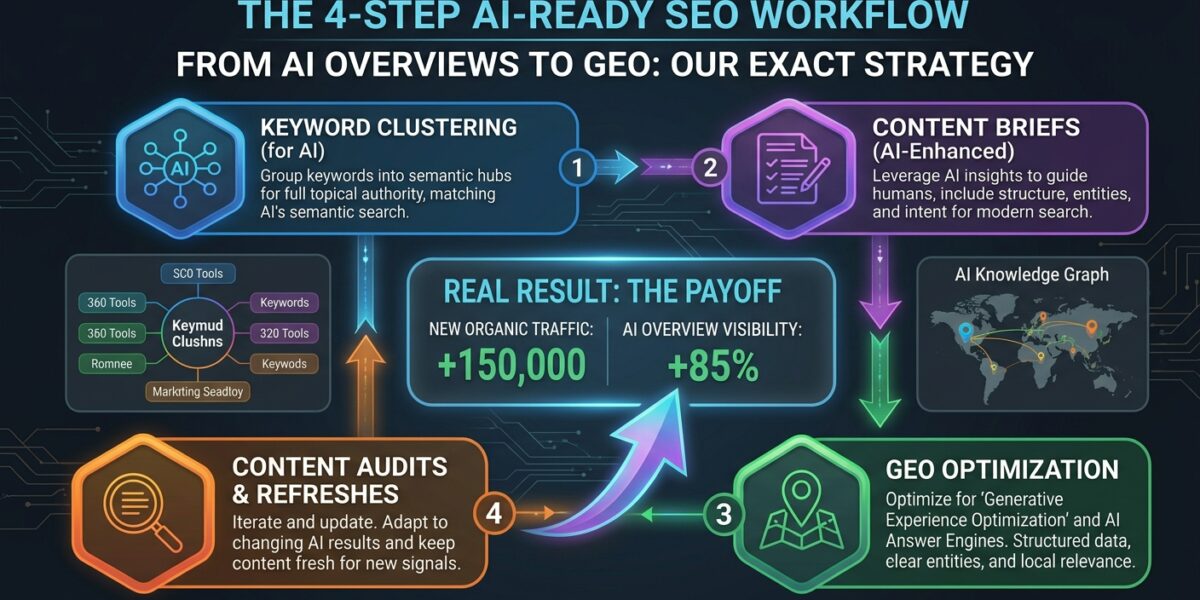
Instead of pulling a flat list of keywords from a tool and picking the highest volume, use ChatGPT to cluster them by search intent first. Paste a raw keyword export and ask it to group terms into informational, commercial, and transactional buckets.
This matters because a $22 CPC keyword with commercial intent (“best project management software for agencies”) is worth far more than a $2 CPC keyword with ten times the volume but purely informational intent (“what is project management”).
Step 2: Building Content Briefs in Minutes, Not Hours
The biggest time sink in content production has always been the brief — outlining what to cover, what competitors already rank for, and what gap you can fill. ChatGPT compresses this from an hour of manual SERP analysis into a five-minute conversation.
Feed it the top 3–5 ranking URLs for your target keyword (copy the headings and key points manually, or paste the full text) and ask for a content gap analysis. It will reliably surface angles the top results are missing — which is exactly what you need to outrank them, not just match them.
Step 3: Optimizing for AI Overviews and Citations (GEO)
Generative Engine Optimization — writing content that gets cited inside ChatGPT, Perplexity, and Google’s AI Overviews — is the single biggest shift in SEO since mobile-first indexing. The tactics are different from classic SEO:
- Answer the question in the first two sentences. AI models extract concise, direct answers — buried leads get skipped entirely.
- Use clear, structured headers. H2s phrased as questions match how people actually prompt AI tools.
- Include original data. A stat, a small original study, or a real screenshot gives models something unique to cite instead of paraphrasing a competitor.
- Keep individual sections self-contained. AI models often extract a single paragraph, not the whole page — each section should make sense in isolation.
Step 4: Using ChatGPT to Audit Existing Content
Don’t just use it for new content — some of the highest-ROI SEO work is refreshing what you already have. Paste an underperforming article and ask ChatGPT to identify where it fails to directly answer the target query, where the structure could be tightened, and what a competitor’s ranking article covers that yours doesn’t.
What ChatGPT Can’t Do
It’s worth being honest about the limits. ChatGPT doesn’t know your real-time rankings, can’t see your actual Search Console data unless you paste it in, and its keyword volume estimates are frequently outdated or simply wrong. Pair it with a real data source — Semrush, Ahrefs, or Google Search Console — for anything involving actual numbers.
It’s also not a substitute for genuine expertise. AI-assisted drafts still need a human editor who has actually used the product, tested the strategy, or lived the experience being written about — which is exactly the E-E-A-T signal Google (and increasingly, AI models themselves) reward.
The Workflow We Actually Use
Every guide on MeziAI follows roughly this sequence: ChatGPT for the initial keyword clustering and content brief, Surfer SEO for on-page optimization scoring, and a human editor — us — for fact-checking, adding real screenshots, and writing the parts that require actually having used the tool being covered.
AI speeds up the parts that used to be mechanical. It doesn’t replace the parts that require judgment.